Kreitler Rollers
When we first considered Pacific Bound 1997, Trish and I realized we
would have to be in pretty good shape to be able to successfully complete
the trip in a reasonable amount of time. This, of course, meant training.
Trish and I would tape shows on TV that we liked, and then play them back
as we trained.
How did we train? We used the mighty Kreitler Dyno-Lyte Roller Trainer.
Kreitler Rollers may be slightly more expensive than the imitations, but
the quality is well worth it. Carefully turned aluminum drums, precision
bearings, and a flexible yet responsive drive system place the Kreitler
Dyno-Lyte Trainer at the top of the trainer pack.
The Kreitler system comes in two variants - the Dyno-Lyte for normal
mortals, and the Dyno-Myte for ultra-serious cyclist. The Dyno-Myte has
smaller drums, making the ride much more difficult. In addition to the
different drum sizes, blowers are available, which drive a fan-like assembly
from the front roller. The "Killer Headwind" blower allows for
variable difficulty riding, as well as a simulated headwind!
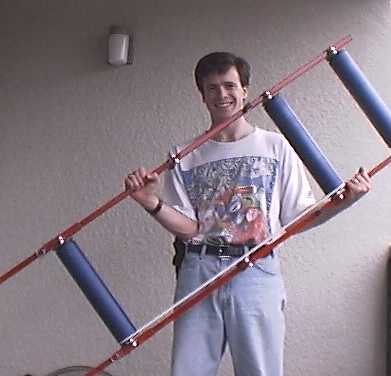 For
those of you who are not familiar with Roller Trainers, consult the picture
below. In the picture, you’re looking down on the Dyno-Lyte; the system
rests on the ground in this way. The rear wheel of the bicycle rides on
the top two drums, which are close enough together that the rear wheel
is cradled by the two drums. The front wheel rests on the bottom drum,
with the front axle riding slightly behind the front drum’s center of rotation.
The white line between the second of the two drums on top and the drum
on the bottom is really a plastic belt which causes the front drum to turn
at the same rate as the rear drum. Without the rotating front drum, the
front wheel would stay still, and the bike would fall over.
For
those of you who are not familiar with Roller Trainers, consult the picture
below. In the picture, you’re looking down on the Dyno-Lyte; the system
rests on the ground in this way. The rear wheel of the bicycle rides on
the top two drums, which are close enough together that the rear wheel
is cradled by the two drums. The front wheel rests on the bottom drum,
with the front axle riding slightly behind the front drum’s center of rotation.
The white line between the second of the two drums on top and the drum
on the bottom is really a plastic belt which causes the front drum to turn
at the same rate as the rear drum. Without the rotating front drum, the
front wheel would stay still, and the bike would fall over.
Obviously, the trainer as shown in the photo did not fit our bicycle.
Al Kreitler, the president and founder of Kreitler Rollers, sent us some
pieces to make a much longer front-end for the trainer, but we ran out
of time. Instead, we attached the front forks of the bike to a block of
wood. Of course, with this "nailed down" approach, we didn’t
get the stability or handling training the roller trainer was meant to
provide. In its normal usage mode, the bike is unattached, and the cyclist
must have excellent balance to avoid riding off the sides of the trainer.
Hopefully, we can extend the rollers at the end of the trip, so we can
experience the challenge of true roller training.
Kreitler Rollers are available at fine bicycle shops everywhere. Experience
the Killer Road Load - get a Kreitler Roller Trainer today!
