Tuesday, August 18, 2009

Weekend in Connecticut

We spent the weekend camping at Housatonic Meadows State Park.  It was very, very hot and muggy, but we had fun exploring the trails near the campground.

On Sunday, we drove down to Woodbury, CT to a recreation of the Battle of Cedar Creek.  600 reenactors simulated a battle which pitted 32,000 Union soldiers against 21,000 Confederate troops.
IMG_6228  

IMG_6230

IMG_6237

IMG_6238

IMG_6246 

Lincoln surveys the Union camp:

IMG_6258

General Grant was in attendance as well:

 IMG_6263 

IMG_6265 

Union guns fire:

IMG_6289 

The Confederate advance cannot be broken:

IMG_6308

Union guns pull back:

IMG_6301

Rebel guns fire:

IMG_6320

Lincoln looks on:

IMG_6368 

The two armies suffered 8,500 casualties on that day:

IMG_6369

The Union forces regroup and press the attack:

IMG_6386

IMG_6387

IMG_6402

IMG_6420

IMG_6462

IMG_6507

IMG_6514

Having pushed back the Rebels, the Union troops return to camp:

IMG_6574 

IMG_6605

General and Mrs. Grant:

IMG_6673 

IMG_6708 

IMG_6662 

We walked through the encampments:

IMG_6588 

IMG_6674

IMG_6684 

IMG_6687

IMG_6689

IMG_6692 

Lincoln reflects:

IMG_6700 

The Union camp:

IMG_6717

IMG_6718 

IMG_6720 

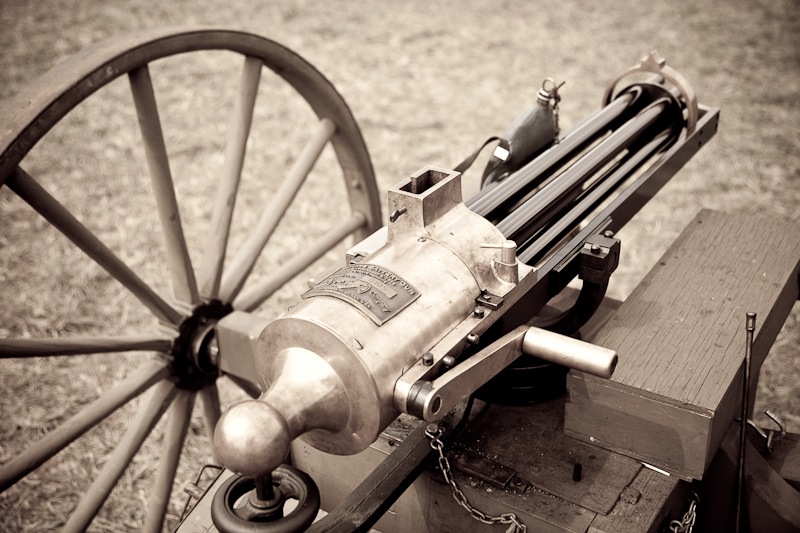
A replica of a Civil War era gatling gun:

IMG_6733

IMG_6734

IMG_6735

Artillery pieces in the field:

IMG_6737

IMG_6742

…On the way home, we stopped in Tarrytown and skated for a while on the North County Trailway.  Baila and I used skates, Trish used blades, and Mechel used his Razor scooter.

Other that the heat and humidity, it was a great weekend!

Tuesday, August 11, 2009

Honda Fit vs. Chevy Volt

Honda Fit: $16000
Cost per mile: 30MPG @ $3.00/gallon = $0.10 per mile

Chevy Volt: $32500 (after tax credit)
Cost per mile: 40 miles per 8KW charge @ $0.15 per KW = $0.03 per mile

….So the Volt pays for itself (relative to the fit) after 235,714 miles.  And that assumes that the batteries never need to be replaced (and that would not be the case, since the car would require 5,892 charge cycles to cover this distance), and that you don’t drive more than 40 miles between charges.  It would take 16 years of driving 40 miles every day to reach the break-even point.

On the other hand, in $9/gallon European countries, the break even point comes after only 61,111 miles.

Pool heating system

This is the third year we’ve had our pool, and it has been really great, but it’s always been a bit chilly.  Last year, we bought solar sun rings, which helped a lot, but the water was still too cool.

Poking around, I found a solution from Gull Industries that used flat coils of black tubing:

image

Here’s their cross-sectional diagram:

image

I figured I could build the same thing.  I used the ends of a large wire spool as the hub, and pairs of 2”x2”s as the support spokes:

IMG_0587

The separation of the pairs of 2”x2”s is most clear at the bottom of this image:

IMG_0588

I then purchased a 400 foot spool of 3/4” irrigation tubing, which has an outer diameter of 9/10”, and wound it around the hub and between the pairs of spokes:

IMG_0590

When completed, the diameter of the units is about 6 feet.  I built two of them and mounted them to a south-facing roof near the pool.  The pool has two drain holes at either end of the pool.  I attached drain plug connectors to the drain holes and used them as the input and output for the system.  A pump sucks the water out of the drain hole, pushes the water through the two heating coils, and back into the other drain hole.

It works very well!  The pool has been very comfortable for the summer so far!

I don’t think it ever made it to the blog, so here goes:  two summers ago I built a crude endless pool style swimming machine.  Looking through patents, it appeared that the key to producing a uniform flow is to use a current straightener, which is a structure that forces the water into parallel streams.  See part 24 below:

image

I built my current straightener using square PVC ballusters, cut into 6” sections and glued together side by side to create a 16” x 8” honeycomb that is 6” deep.  Behind this I placed a pair of low power trolling motors.  Total cost was about $200, compared to $2500 or so for a commercial swimming machine.

The machine worked well, but I think I would need a third trolling motor to hold me back when swimming at full force.  Here’s a video:


Sunday, August 2, 2009

All caught up!

OK, I’ve backfilled all of our adventures from April through July, so feel free to take a look.